
Answering: What Does a Bookkeeper Actually Do vs What Does a CPA Do?
Estimated reading time: 10 min read
The difference between a bookkeeper and a CPA in Austin comes down to one handling your ongoing monthly financial work while the other handles strategic tax planning and compliance that requires state licensure. Yes, you likely need both working together, and that combination typically saves Austin service businesses money rather than costing more. Based on AliCat Solutions's experience with local clients, one Cedar Park consulting firm saw their CPA bill drop from $4,200 to $1,800 after just one year of properly maintained monthly books because their CPA could focus on actual tax work instead of reconstructing records.
If you're a new business owner in Austin or Cedar Park, the confusion makes sense. Nobody explains this clearly, and you've probably received conflicting advice about which professional to hire first. You might be doing your own books in spreadsheets, dreading tax season, or wondering why your CPA bill seems so high for what feels like basic work.
The reality is that bookkeepers and CPAs serve completely different functions under Texas law. The Texas State Board of Public Accountancy requires CPAs to complete 150 semester hours of education and pass a rigorous state exam. Bookkeepers have no licensing requirement in Texas, which means quality varies dramatically. Success depends on finding professionals who communicate with each other and understand their distinct roles.
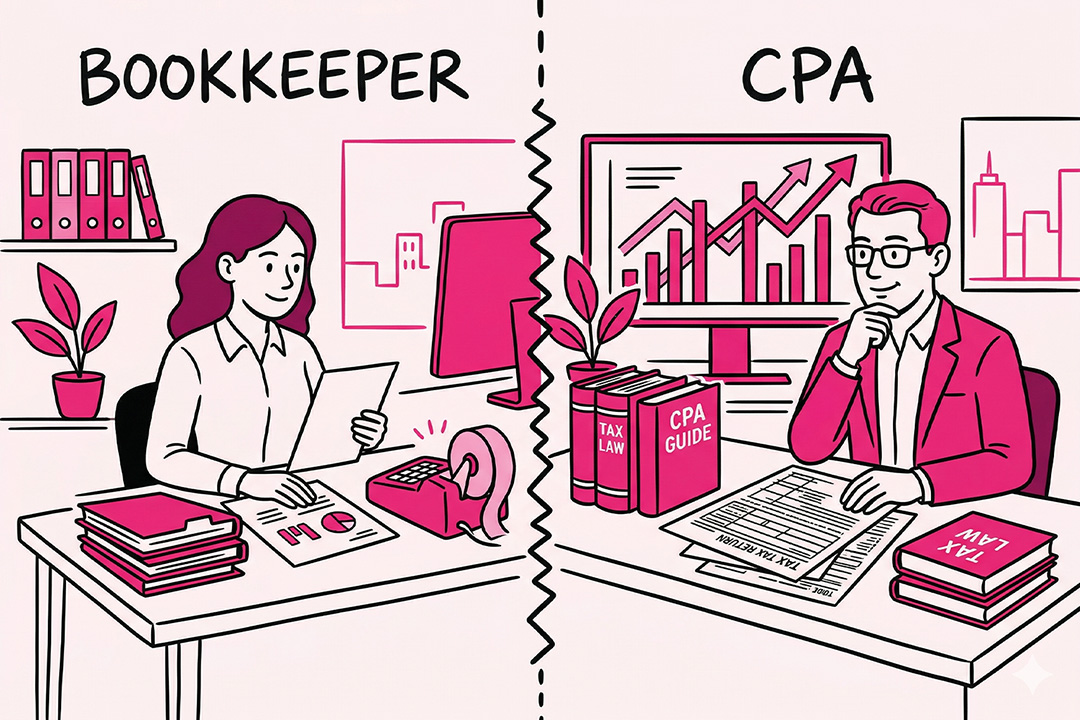
Bookkeepers handle the ongoing monthly work: categorizing transactions, reconciling accounts, producing monthly financial statements, managing payroll, tracking receivables and payables. CPAs handle strategic work: tax planning, tax return preparation, audit representation, and complex compliance. Clean monthly books mean your CPA does tax prep, not archaeology. This guide breaks down exactly what each professional does so you can make informed decisions for your Austin area business.
Key Insights
- Austin service businesses that maintain clean monthly books typically save between $1,000 and $2,400 annually on CPA fees.
- The key is understanding which professional handles which tasks and making sure they work together throughout the year rather than scrambling at tax time.
Keep reading for full details below.
Table of Contents
- What Bookkeepers Actually Do Day to Day
- What CPAs Are Licensed to Do That Bookkeepers Cannot
- How Austin and Cedar Park Startups Save Money with Both
- Frequently Asked Questions
- Want to Learn More?
- Citations
What Bookkeepers Actually Do Day to Day
A bookkeeper manages all the transactional work that keeps your financial records accurate and current. This includes categorizing every expense, reconciling your bank accounts monthly, tracking invoices you've sent and payments you've received, and ensuring every dollar is accounted for correctly. This daily and weekly maintenance prevents cash flow blindness and keeps your records ready if you ever face an audit.
The tangible output of bookkeeping is your monthly financial statements. A Balance Sheet shows what your business owns and owes at a specific point in time. A Profit and Loss statement shows your revenue, expenses, and profit over a period. Together, these reports tell you exactly where your business stands financially so you can make informed decisions.
Quality matters enormously in bookkeeping because errors compound over time. A miscategorized expense in January becomes a tax problem in April. An unreconciled bank account hides cash flow issues until they become emergencies. CPA-supervised bookkeeping in Austin provides a layer of quality control that solo bookkeepers cannot offer. AliCat Solutions delivers monthly Balance Sheet and Profit and Loss statements by the 15th business day, every month, with CPA review before anything reaches your hands.
The team behind your books matters too. Experience levels vary widely among bookkeepers, and Texas has no licensing requirements to filter out underqualified providers. Look for teams with verifiable credentials, certifications in platforms like Xero or QuickBooks, and a clear review process.
Action steps to consider:
- Review how often you currently receive financial statements. If it's less than monthly or arrives inconsistently, you're working with outdated information.
- Ask your current bookkeeper who checks their work for accuracy before it reaches you.
What CPAs Are Licensed to Do That Bookkeepers Cannot
CPAs hold credentials that bookkeepers legally cannot obtain without meeting strict state requirements. The Texas State Board of Public Accountancy requires CPA candidates to complete 150 semester hours of college education, pass the Uniform CPA Examination, and maintain ongoing continuing education. These requirements exist because CPAs perform work with significant legal and financial implications.
Only CPAs can legally sign audited financial statements that lenders and investors require. Only CPAs can represent you before the IRS if you face a dispute or audit. Only CPAs can provide attestation services or binding tax advice that you can rely on for compliance purposes. When you need someone to sign off on numbers that banks, investors, or the IRS will scrutinize, you need a CPA.
For Austin service businesses, CPAs handle franchise tax obligations, quarterly estimated payment calculations, and complex deduction strategies. Texas has no state income tax, but that doesn't mean tax planning is simple. The bookkeeper vs CPA Austin distinction matters most when navigating these Texas-specific requirements that affect your bottom line throughout the year.
Understanding this division helps you use each professional efficiently. Your CPA's time costs more per hour than your bookkeeper's time. Every hour your CPA spends organizing receipts or reconstructing records is an hour not spent on strategy that could save you money.
Action steps to consider:
- Verify any CPA's active license status through the Texas State Board of Public Accountancy website before hiring.
- Ask your CPA what percentage of your last bill covered actual tax planning versus cleanup work.
How Austin and Cedar Park Startups Save Money with Both
The math is straightforward. A Cedar Park consulting firm paid their CPA $4,200 one year when books were disorganized. After twelve months of properly maintained monthly bookkeeping, that same CPA bill dropped to $1,800. The CPA did tax preparation and strategy work instead of financial archaeology, and the client saved $2,400 while getting better service.
Service businesses in Austin face unique financial patterns. Consultants, contractors, attorneys, healthcare providers, IT firms, and creative agencies all have project-based revenue, variable expenses, and timing considerations that benefit from specialized attention throughout the year. When your bookkeeper and CPA communicate regularly, proactive tax planning replaces the reactive scrambling that happens when everyone sees the numbers for the first time in February.
The bookkeeper vs CPA Austin question isn't about choosing one or the other. It's about using each professional for their core strength. Your bookkeeper maintains clean books monthly so your CPA can focus on estimated payment strategy, deduction planning, and preparation. AliCat Solutions exclusively serves service-based businesses, delivering monthly financials by the 15th business day under contractual guarantee, which means your CPA receives clean data on a predictable schedule.
Mid-year communication between your bookkeeper and CPA catches opportunities while adjustments can still be made. A strategy conversation in May gives you seven months to implement changes before year-end.
Action steps to consider:
- Calculate what you paid your CPA last year and itemize how much was actual tax work versus cleanup or extension costs.
- Request a mid-year check-in between your bookkeeper and CPA to review tax planning opportunities.
Understanding the distinct roles of bookkeepers and CPAs helps Austin area business owners make smarter decisions about their financial team. Clients consistently report that organized, reconciled books change their relationship with tax season entirely. When your monthly financials arrive on time and your CPA receives clean data, you stop dreading the process and start using financial information to grow your business.
For a deeper look, visit https://alicatsolutions.com/about
Frequently Asked Questions
Q: Can a bookkeeper do everything a CPA does?
A: No—and that's actually a good thing for your budget and compliance. Bookkeepers handle ongoing monthly work: categorizing transactions, reconciling bank accounts, and producing financial statements (Balance Sheet, P&L). CPAs are licensed professionals who passed the Texas State Board of Public Accountancy exam and can legally do things bookkeepers cannot: sign audited financial statements, represent you before the IRS, file certain tax documents, and provide binding tax strategy advice. The smartest approach for Austin service businesses is using each professional for their core strength. Your bookkeeper maintains clean books monthly so your CPA can focus on tax planning, estimated payment strategy, and preparation—not chasing receipts or reconstructing records. This division of labour typically saves $1,000–$2,400 annually compared to having your CPA do everything at their higher hourly rate.
Q: How often should I communicate with both my bookkeeper and CPA?
A: Monthly bookkeeping should be your baseline—you'll receive clean financial statements by the 15th business day so you know exactly where you stand. With your CPA, quarterly check-ins during your fiscal year catch tax planning opportunities while adjustments can still be made, and annual tax preparation is standard. Many Austin service businesses also find a mid-year conversation (April–May for calendar-year businesses) invaluable for proactive strategy instead of year-end scrambling.
Q: What's the timeline for seeing savings after I switch to CPA-supervised bookkeeping?
A: Most service business clients recover their bookkeeping investment within three to four months through recovered time alone—hours you're no longer spending on financial organisation instead of revenue-generating work. The real savings appear at tax time. A Cedar Park consulting firm saw their CPA bill drop from $4,200 to $1,800 after their first year with properly maintained monthly books, because their CPA did actual tax preparation and strategy instead of financial archaeology.
Q: How do I know if my current bookkeeper is doing the job right?
A: Ask three questions: Do you receive monthly financial statements by a consistent deadline? Who reviews their work for accuracy before delivery? Can they clearly explain your profit margin, cash position, and tax obligations? If the answer to any is "I'm not sure," it's time to have a direct conversation—or consider a change. Your bookkeeper should be accessible, responsive (ideally within one business day), and able to answer basic financial questions about your business without delay.
Want to Learn More?
We've drawn on decades of accounting experience and industry expertise to create this comprehensive guide for Austin and Cedar Park service business owners trying to understand who handles what—and why the division matters to your bottom line.
Citations
- "Texas State Board of Public Accountancy (TSBPA) Certification Requirements" — The TSBPA mandates that CPAs complete 150 semester hours of college education and pass the Uniform CPA Examination before they can legally represent clients before the IRS, sign audited statements, or provide binding tax advice. This is the regulatory foundation that distinguishes licensed CPAs from unlicensed bookkeepers in Texas. https://www.tsbpa.texas.gov/exam-qualification/certification-requirements.html
- "Texas State Board of Public Accountancy Main Site" — The TSBPA oversees all CPA licensing, continuing education, and ethics requirements in Texas. You can verify your CPA's active licence status through this official resource before engaging their services. https://www.tsbpa.texas.gov/
- "Texas State Board of Public Accountancy Certification Overview" — This resource clarifies the distinction between certified public accountants and unlicensed bookkeepers, reinforcing why CPA supervision of bookkeeping work creates measurable quality control differences. https://www.tsbpa.state.tx.us/exam-qualification/certification.html
In Texas, bookkeepers are unlicensed professionals, and quality varies dramatically without CPA oversight. The regulatory distinction exists for a reason: CPAs carry professional liability, continuing education requirements, and legal accountability that protect your business and ensure compliance with both state and federal standards.
If you'd like to learn more, visit https://alicatsolutions.com/about to explore how we approach CPA-supervised bookkeeping and what it means for your Austin or Cedar Park service business.
You've probably heard you need both a bookkeeper and a CPA, but until now, nobody actually explained what each one does—or why paying for both might actually save you thousands. The reality is straightforward: clean monthly books eliminate the expensive scramble at tax time, freeing your CPA to do what they do best (strategy, planning, compliance) instead of playing financial detective. Clients consistently report their CPAs charge significantly less when they receive organised, reconciled books instead of a shoebox of receipts. If you're tired of dreading tax season, wondering where your money actually goes each month, or paying premium CPA rates for bookkeeping cleanup, this is your signal to act. Your financials don't have to be another source of stress—and with the right partnership, they become your competitive advantage.
Quality Verified
This content scored 90% in the Probably Genius Publication Readiness Assessment, meeting standards for direct answers, section depth, proof points, citation quality, and AI extractability.