She lost her job, so she built two businesses. One keeps Austin's small companies afloat. The other might be quietly rewriting what a generation of kids think they're allowed to do.
Alicia Hoffman does not look like a woman who started a revolution in a Cedar Park living room. She looks like someone who would rather you got to the point. Twenty years as a CPA will do that to a person. So will running two companies at once.
"Times have changed," she says, in the matter-of-fact tone of a woman delivering a balance sheet. "In 2017, only 16 percent of Fortune 500 companies even offered a pension plan to their employees. In our gig economy, 49 percent of Americans under the age of 35 make money by running a side hustle. A third of all Americans are considered self-employed."
She pauses. The numbers are not meant to be impressive. They are meant to be a problem.
"How," she asks, "are we preparing our youth for that?"
It is a question that arrived in her life uninvited. Hoffman spent two decades inside corporate finance, doing the work she had been trained for and trusted by the system that had trained her. Then, like millions of Americans in the post-2008 reshuffling, she was laid off. The system she had served declined to keep its end of the bargain.
What she did next is the kind of story economists like to file under "resilience" and parents like to file under "I should be doing more." She started a CPA firm — AliCat Solutions — and within months, started a second business alongside it. A summer camp. For children. About entrepreneurship.
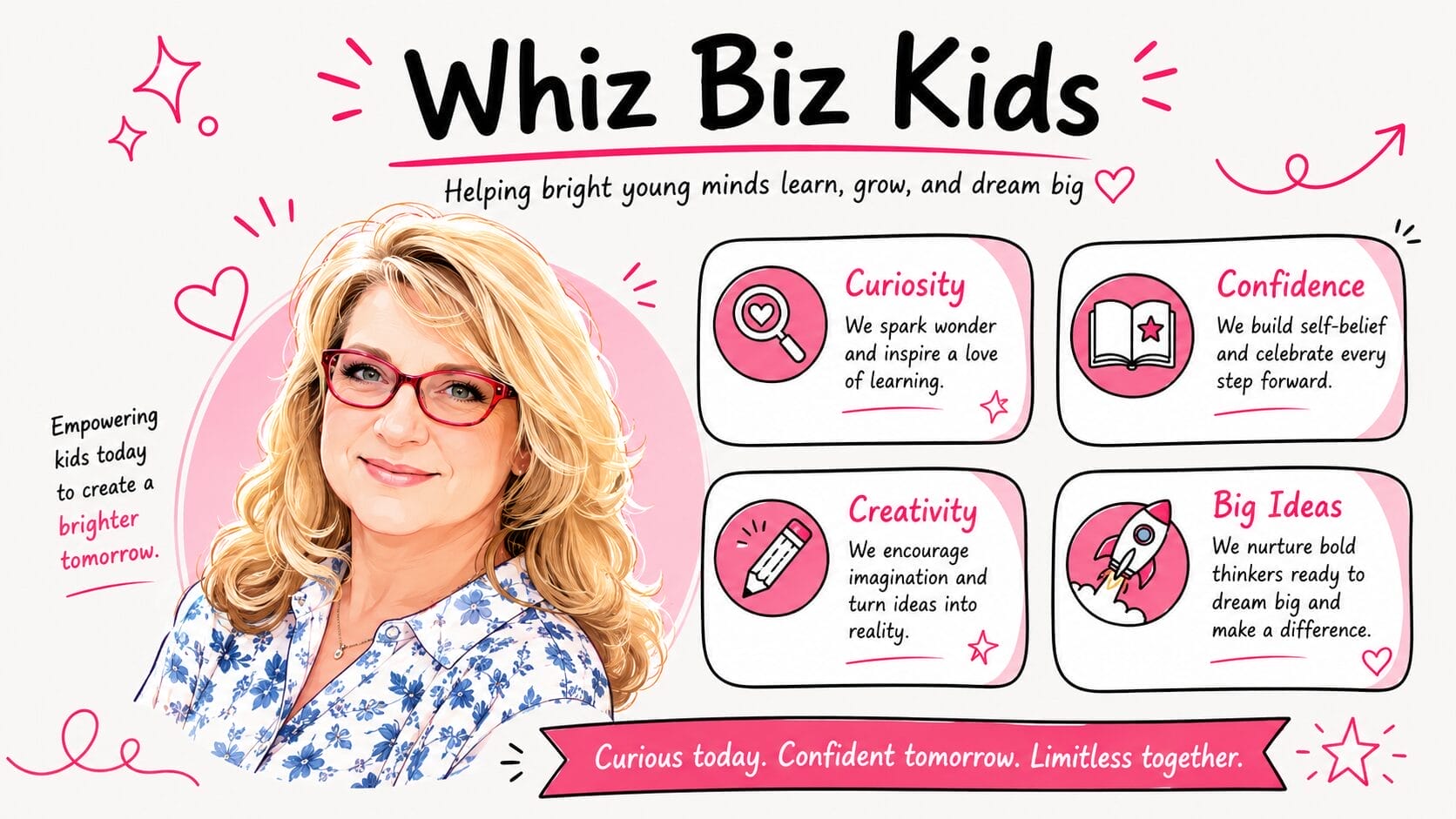
The second business is called Whiz Biz Kids, and on the day I spoke to its founder, she was halfway between a conversation about quarterly bookkeeping and a curriculum review for schools in Latin America.
"I made it my mission," she says, "to show kids that there's another path to financial success."
The camps are not what you might imagine.
There is no inspirational poster about following your dreams. There are no certificates of participation. What there is, instead, is a room full of nine-year-olds arguing about pricing.
Children at Whiz Biz Kids do not learn about business. They run one. In teams, over the course of a week, they invent a product, name a company, build a pitch, and present to a panel of "investors" — often parents who arrive expecting cute and leave faintly stunned. One year, a team of campers built a product called Parana Pet. A piranha. As a household companion.
"The kids have a strong sense of ownership from the very beginning," Hoffman says. "They take on roles such as CEO, CFO, marketing manager. They develop a newfound confidence in their own ability to achieve financial success and accomplish whatever they choose."
She is not selling it. The conviction is too settled for that. This is what she has watched happen, week after week, summer after summer, for six years.
What kind of nine-year-old, you might ask, has a market thesis on freshwater predators?
The answer, increasingly, is: more than you would think. And the woman teaching them did not arrive at this work by accident.
To understand why a corporate CPA started a children's business camp, you have to understand what twenty years inside other people's finances will show you.
Hoffman watched the deal change in real time. The clients she had counseled at the start of her career — W-2 employees with pension plans and predictable retirements — were not the clients she counseled by the end. By the end, she was helping freelancers calculate quarterly estimated taxes. She was helping young business owners with no template for any of it, because their parents had never needed one. She was watching, from the cleanest possible vantage point — the books — the slow unwinding of the postwar economic compact.
And then she had her own children.
"As a parent," she says, "I wanted my kids to be prepared with the entrepreneurial tools they needed to be successful."
It is the kind of sentence that, said quickly, could be mistaken for a marketing line. Said by Hoffman, who has read the data and audited the spreadsheets and watched the trend lines bend, it lands differently. She is not speculating about the future. She is reporting from inside it.
The question becomes harder to dismiss. If the path her parents walked is gone, and the path she walked is going, what exactly are we teaching the children?
"The hands-on learning sets us apart," she says, "because it's their idea, their product, and their business." The distinction matters. At Whiz Biz Kids, the kids are not memorizing the parts of a business plan. They are making one. They are pricing wrong, and watching what happens. They are pitching to a room and feeling the difference between a yes and a polite smile. They are practicing being wrong in public — a muscle most adults do not develop until they are well into their thirties and have considerably more to lose.
"This unique opportunity to make their own decisions and learn from their mistakes," Hoffman says, "shifts their mindset and gives them the courage to follow their dreams."
She would never use the word revolution. She is a CPA. CPAs do not traffic in that vocabulary. But it is hard to spend an hour with her and not wonder if the word fits anyway.
The other business — the one that pays the bills, the one that brought her here in the first place — is AliCat Solutions. From a small office in Cedar Park, Hoffman and a team of CPAs and bookkeepers run the financial back office for service businesses across Central Texas and increasingly across all fifty states. The work is precise, unglamorous, and almost completely invisible when it is done well.
It is also, in its way, of a piece with the camps.
"I experienced this economic shift firsthand," she says of her early years after the layoff. "After being laid off, I started my own accounting business along with Whiz Biz Kids, and never looked back."
The two businesses are not really separate. They are two answers to the same question, posed at two scales. The camp answers it for nine-year-olds. The firm answers it for the thirty-eight-year-old graphic designer who finally went out on her own and now needs someone to explain what a sales tax filing is. Both are, in Hoffman's view, the same essential work: equipping people for the economy they actually live in, not the one the textbooks describe.
What is striking, talking to her, is how little she separates the two in her own telling. The CPA and the camp director are the same woman, working on the same problem, from opposite ends of the timeline.
"I believe we live in an era," she says, "where you can be successful by creating a business for anything you are passionate about. Financial success now includes being entrepreneurial."
She means it as an observation. It functions, almost despite her, as an argument.
Whiz Biz Kids has grown. Word, as word does in a place like Central Texas, has gotten out. Hoffman has brought on Jazmin as a full-time curriculum developer because the demand has outpaced what one woman can write on weekends. The curriculum is heading into schools — not only in the United States but in Latin America, where the appetite for entrepreneurial education is, by all accounts, considerable.
None of this, Hoffman is quick to say, was the plan. The plan was to give her own children a set of tools she had not been given. The rest happened because she was not, it turned out, the only parent asking the question.
"For the last six years," she says, "Whiz Biz Kids has been delivering pop-up business camps where campers create a vision and see it through to completion."
It sounds modest. It is not. Six years of curriculum, scaled into schools across two continents, run alongside a full CPA practice, by a woman who began the whole enterprise from the wreckage of a corporate layoff. There is a word for what that takes, and it is the word Alicia Hoffman would be the last person in the room to use.
So someone else has to say it.
She has capacity. The kind that gets noticed in rooms she has not yet walked into.
I asked her, before we ended, what she would say to a parent who was not sure their child was the "entrepreneurial type."
She thought about it for a moment.
"The entrepreneurial instinct isn't a personality trait," she said. "It's a muscle. You build it the same way you build any muscle — by doing the thing, being wrong, adjusting, and doing the thing again."
It is, I think, the most honest sentence anyone has said to me about education in a long time. It is also, not coincidentally, a sentence that could only be said by a woman who has spent twenty years inside the numbers and six years inside the camps and a lifetime, by the sound of it, paying attention.
Two businesses. One question. A generation of children learning, in small rooms in Cedar Park, that they are allowed to make something.
It is not a bad way to spend a life.
— Profile of Alicia Hoffman, CPA. Founder, AliCat Solutions and Whiz Biz Kids.
Related reading